
Table of Contents
How to Increase Deep Sleep (Backed by Sleep Science, Not Guesswork)
If you’ve ever woken up after eight hours in bed and still felt like you got hit by a truck, you already know something the sleep trackers confirm every day: not all sleep is equal. You can rack up plenty of hours and still miss out on the stage that actually does the repair work — deep sleep.
This guide walks through what deep sleep actually is, how much you need, what’s quietly stealing yours, and the specific changes that move the needle — not vague “get more rest” advice, but things you can start tonight.
What Is Deep Sleep, Really?
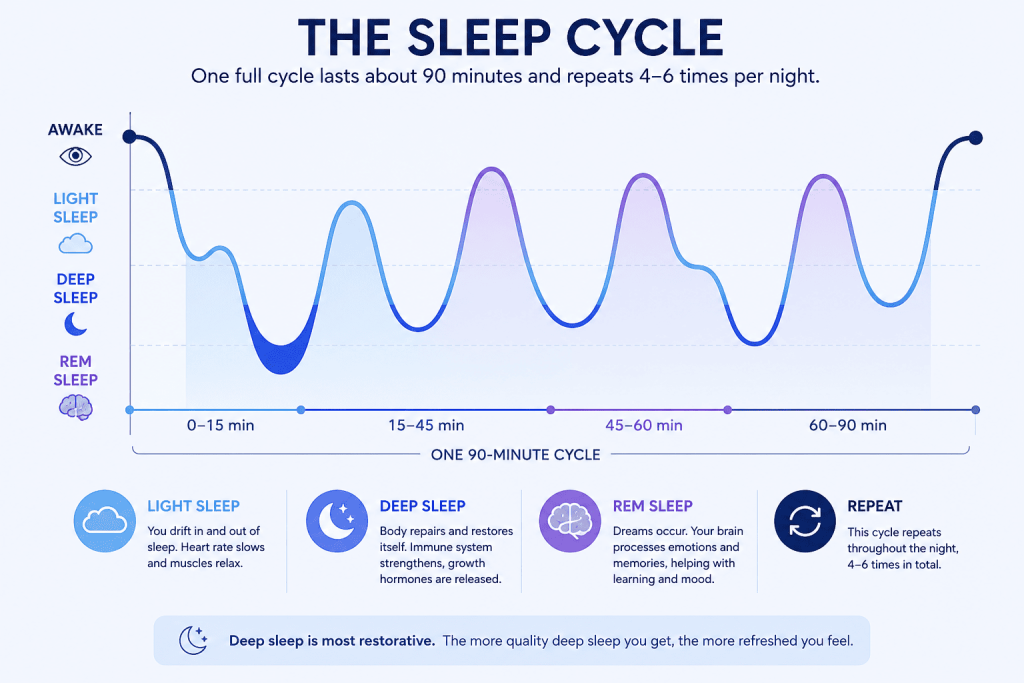
Sleep isn’t one uniform state. Each night, you cycle through several stages roughly every 90 minutes:
- Light sleep (N1/N2): the transition zone — easy to wake from, makes up most of your night
- Deep sleep (N3, also called slow-wave sleep): your brain waves slow way down, your body temperature drops, growth hormone is released, and physical repair happens
- REM sleep: where most dreaming occurs and where a lot of memory consolidation happens
Deep sleep is concentrated in the first half of the night, which is exactly why staying up late or having a rough first sleep cycle costs you disproportionately more of it than losing the same hour later in the night.
Why Deep Sleep Matters More Than Total Hours
Many people notice they can sleep nine hours and still feel foggy — that’s usually a deep sleep problem, not a duration problem. During deep sleep, your body:
- Repairs muscle tissue and clears metabolic waste from the brain (via the glymphatic system)
- Releases the majority of your daily growth hormone
- Strengthens immune function
- Consolidates certain types of memory
When deep sleep is short-changed, you can technically hit your “8 hours” and still wake up sore, foggy, or irritable.
How Much Deep Sleep Should You Get?
| Age Group | Typical Deep Sleep % of Total Sleep |
|---|---|
| Children | 20–25% |
| Young adults | 13–23% |
| Middle-aged adults | 10–15% |
| Older adults (65+) | 5–10% |
Deep sleep naturally declines with age — this is normal, not necessarily a red flag, though it’s still worth optimizing.
What’s Quietly Stealing Your Deep Sleep
Before the fixes, it helps to know the usual suspects:
- Alcohol — often marketed as relaxing, but it suppresses deep sleep and fragments the back half of your night
- Late caffeine — has a half-life of 5–6 hours, so a 3pm coffee is still partly active at 9pm
- Irregular sleep/wake times — confuses your circadian rhythm, delaying when deep sleep even starts
- A too-warm bedroom — your core temperature needs to drop to enter deep sleep
- Chronic stress — elevated cortisol interferes with the transition into slow-wave sleep
15 Ways to Increase Deep Sleep
1. Keep a consistent sleep and wake time — even on weekends.
Your circadian rhythm anchors deep sleep timing. Bouncing your wake-up time around by 2+ hours on weekends (a real phenomenon sometimes called “social jet lag”) pushes deep sleep later and shortens it.
2. Cool your bedroom down.
Most sleep researchers point to somewhere around 65°F (18°C) as a good starting point. Your core body temperature has to drop for deep sleep to kick in — a hot room fights that process directly.
3. Cut caffeine earlier than you think you need to.
If you’re sensitive, an early afternoon cutoff (not just “no coffee after dinner”) makes a real difference.
4. Limit alcohol, especially close to bedtime.
If you drink, having it earlier in the evening — rather than right before bed — reduces the deep-sleep disruption.
5. Get morning sunlight.
Bright light exposure within the first hour of waking helps set your circadian clock, which indirectly strengthens deep sleep later that night.
6. Exercise — but not right before bed.
Regular moderate exercise is one of the more consistently supported ways to increase deep sleep. Timing matters: intense workouts within an hour or two of bedtime can raise core temperature and adrenaline right when you’re trying to wind down.
7. Build a real wind-down routine.
Dimming lights, stepping away from screens, and doing something low-stimulation for 30–60 minutes before bed helps melatonin do its job instead of fighting blue light.
8. Manage stress before bed, not in bed.
If you’ve ever lain there running through tomorrow’s to-do list, you know cortisol and deep sleep don’t mix. A short journaling or breathing practice earlier in the evening can help more than trying to force your brain to stop at midnight.
9. Try slow, controlled breathing as a wind-down tool.
Simple techniques (like extending your exhale longer than your inhale) can shift your nervous system toward rest.
10. Avoid heavy meals close to bedtime.
Digestion competes with the temperature drop your body needs for deep sleep.
11. Consider magnesium-rich foods or a magnesium supplement.
Magnesium is involved in nervous system regulation, and low intake is common. This isn’t a guaranteed fix, but it’s a low-risk one worth discussing with a doctor if your diet is light on it.
12. Use blackout curtains or an eye mask.
Even small amounts of light can disrupt sleep architecture, particularly in the second half of the night when REM (which is light-sensitive) increases.
13. Keep your bedroom for sleep, not scrolling.
This is basic sleep hygiene, but it’s underrated — training your brain to associate the bed with sleep (not stimulation) helps you fall asleep faster, which gives you more total time available for deep sleep.
14. Try a weighted blanket if you carry tension at night.
Some people find the gentle, even pressure helps them settle faster — though the research here is still mixed, and it’s more about personal comfort than a proven deep-sleep booster.
15. If the basics are dialed in and you still want extra support, some people look into a sleep-focused supplement.
This is where something like Sleep Revive fits — not as a replacement for the fundamentals above, but as an additional layer once your sleep hygiene is already solid. More on this below.
Mistakes People Make Trying to “Hack” Deep Sleep
- Chasing a sleep score obsessively. Trackers are estimates, not medical-grade EEG. Stressing over the number can itself hurt sleep.
- Relying on alcohol as a sleep aid. It may help you fall asleep faster but actively reduces deep sleep quality.
- Assuming supplements alone will fix a bad sleep schedule. No pill outworks an inconsistent bedtime or a too-warm room.
- Overcorrecting with naps. Long or late naps can reduce “sleep pressure,” making it harder to reach deep sleep efficiently at night.
How to Track Your Deep Sleep
Consumer wearables (Oura Ring, Whoop, Fitbit, Apple Watch) estimate sleep stages using heart rate variability and movement. They’re not as precise as a clinical polysomnography study, but they’re genuinely useful for spotting trends — for example, noticing your deep sleep consistently drops on nights you drink or exercise late.
Buying Guide: When a Sleep Supplement Might Help
If you’ve worked through the habit changes above — consistent bedtime, cooler room, earlier caffeine cutoff, less alcohol — and you’re still looking for extra support, a sleep supplement is one option some people explore.
Sleep Revive is a sleep supplement taken as two capsules 30–45 minutes before bed. It’s made with vegetarian capsules, non-GMO, and manufactured in a GMP-certified facility in the US. It’s available as a one-time purchase or a subscription, and it comes with a 60-day money-back guarantee if it’s not the right fit for you.
Who might consider it:
- People who’ve already tightened up their sleep hygiene and want to try an additional layer of support
- People who prefer not to rely on prescription sleep aids or melatonin long-term
Who should check with a doctor first:
- Anyone pregnant, breastfeeding, or managing a chronic condition
- Anyone currently taking prescription medication, including sleep medication
When to See a Doctor
Loud snoring, gasping awake, morning headaches, or daytime sleepiness despite “enough” sleep can point to sleep apnea or another disorder that lifestyle changes alone won’t fix — that’s worth a real sleep study, not just a supplement or a cooler room.
FAQ
What is deep sleep?
Deep sleep (slow-wave sleep) is the stage where brain activity slows significantly, body temperature drops, and physical repair — including growth hormone release and immune support — happens most intensively.
How much deep sleep should I get per night?
Most adults get roughly 13–23% of total sleep as deep sleep, translating to about 1–2 hours a night, with the exact amount declining naturally with age.
Can you increase deep sleep naturally?
Yes — consistent sleep/wake times, a cool dark room, morning sunlight, regular exercise (not too close to bedtime), and cutting late caffeine and alcohol are the most reliably supported methods.
Does alcohol affect deep sleep?
Yes. Alcohol can help you fall asleep faster but suppresses deep sleep and increases disruptions later in the night.
Do sleep trackers accurately measure deep sleep?
They’re estimates based on movement and heart rate, useful for spotting trends over time, but not as precise as a clinical sleep study.