
Most people fail at creating habits not because they lack motivation, but because they build habits in a way the brain naturally resists.

If you’ve ever promised yourself you would:
- Wake up early
- Exercise consistently
- Study every day
- Read more books
- Journal regularly
- Stop procrastinating
- Build a healthier routine
…only to quit after a few days, you are not lazy.
You were probably using the wrong system.
The truth is, habit formation is less about willpower and more about psychology, environment, identity, and repetition. Once you understand how habits actually work, creating positive routines becomes dramatically easier.
This guide will teach you exactly how to create habits that last using modern behavioral science, practical psychology, and proven systems developed by researchers and experts like James Clear, Charles Duhigg, and BJ Fogg.
Whether you want to build healthy habits, create a study routine, develop a reading habit, or completely redesign your lifestyle, this article will help you do it in a realistic and sustainable way.
Table of Contents
Why Most Habits Fail
Most people start habits emotionally.
They feel inspired on Monday. Motivated after watching a video. Excited after reading a self-improvement book.
So they suddenly try to:
- Wake up at 5 AM
- Exercise 2 hours daily
- Meditate every morning
- Read 50 pages a day
- Completely change their life overnight
And within a week, everything collapses.
Why?
Because motivation is temporary. Systems are permanent.
The brain hates dramatic change because change requires energy. Your mind is constantly trying to conserve effort and return to familiar patterns — a concept psychologists call cognitive ease.
When a new behavior demands too much mental or physical effort, the brain classifies it as a threat to efficiency. It pushes back. It finds excuses. It returns to what is familiar.
That means successful habits are not built through intensity.
They are built through consistency.
There is also a second, less obvious reason habits fail: the reward is too far away.
When you exercise, the physical results take weeks to appear. When you read, the knowledge compounds slowly. When you study, the payoff arrives months later. The brain’s reward system runs on immediacy — which is why scrolling social media for five minutes feels more satisfying than working out for thirty.
Understanding this mismatch is the first step toward fixing it.
What Is a Habit?
A habit is a behavior repeated so many times that it becomes automatic.
Your brain creates habits to save mental energy. According to research from MIT, up to 40–45% of what people do every day is habit rather than conscious decision-making.
That is why you:
- Brush your teeth without thinking
- Check your phone automatically
- Follow the same morning routine daily
- React emotionally in predictable ways
The brain loves automation. When a behavior becomes habitual, it shifts from the prefrontal cortex (conscious decision-making) to the basal ganglia, a deeper brain region that operates without deliberate effort.
The goal is to make positive behaviors automatic instead of relying on motivation every day.
The Science Behind Habit Formation
In his book The Power of Habit, journalist and author Charles Duhigg popularized the concept of the habit loop — a three-part neurological pattern the brain follows to encode repeated behaviors.
James Clear later expanded this model in Atomic Habits, and behavioral scientist BJ Fogg contributed the Tiny Habits framework, which argues that the key to lasting change is making new behaviors so small they are nearly impossible to fail at.
Together, these frameworks are grounded in decades of behavioral psychology research on how the brain forms and automates behavior.
The Habit Loop: Cue → Craving → Response → Reward
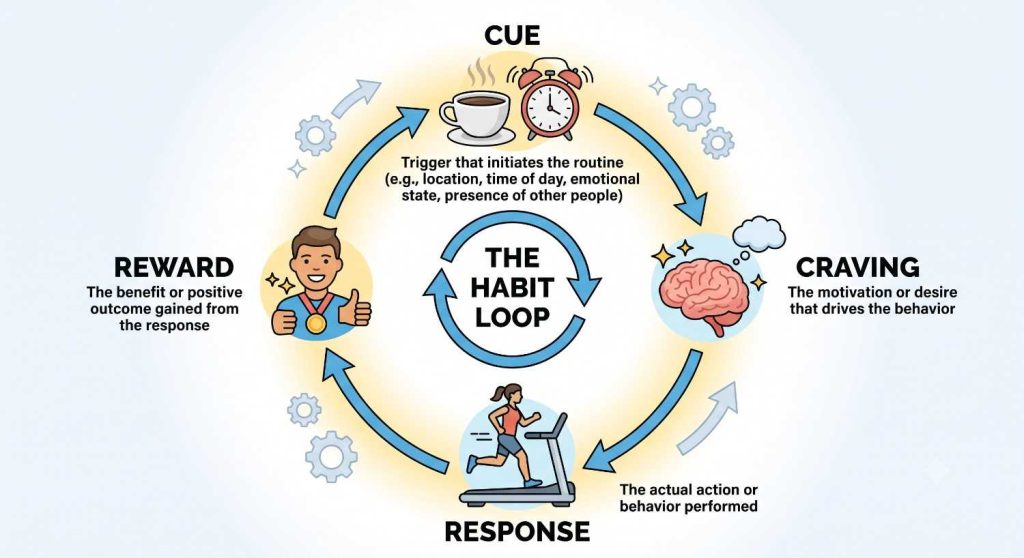
Most habits follow this psychological loop:
Cue → Craving → Response → Reward
| Stage | What It Means | Example (Good Habit) | Example (Bad Habit) |
|---|---|---|---|
| Cue | The trigger that starts the behavior | Sitting in bed at night | Feeling bored |
| Craving | The desire the cue creates | Relaxation | Stimulation |
| Response | The action you take | Reading 10 pages | Opening social media |
| Reward | The outcome that reinforces the loop | Feeling calm and accomplished | Temporary entertainment |
Once the brain connects these loops repeatedly, the behavior becomes automatic.
This is why bad habits feel effortless and good habits feel difficult initially.
Your brain already has strong neural pathways for old behaviors. New habits require building new ones — a process called neuroplasticity, the brain’s ability to reorganize itself by forming new neural connections throughout life.
To create a new habit, you design a new loop. To break a bad habit, you interrupt the existing loop.
How Long Does It Actually Take to Build a Habit?
You have probably heard that habits form in 21 days.
That idea became popular through self-help culture — but the science tells a different story.
A landmark study by Phillippa Lally and colleagues at University College London (2010) found that it takes an average of 66 days for a new behavior to become automatic. The range in their study was 18 to 254 days, depending on the person and the complexity of the habit.
Key takeaway: There is no universal timeline. Some habits click faster. Others take months. What matters is not how quickly the habit forms — it is how consistently you show up during the formation period.
Consistency rewires the brain gradually. Repetition is the mechanism. Time is just the container.
How to Create a Habit Successfully (8-Step System)
Step 1: Start Extremely Small
This is where most people fail.
They make the habit too difficult too early.
Stanford behavioral scientist BJ Fogg calls this the Tiny Habits approach: start with a behavior so small it almost feels ridiculous.
If you want to exercise, don’t start with 90-minute workouts. Start with:
- 5 pushups
- 10-minute walks
- One yoga session per week
If you want to build a reading habit:
- Read 2 pages daily
- Keep a book beside your bed
- Read before checking your phone
Small habits remove resistance. And consistency matters more than intensity.
Key principle: Tiny habits repeated consistently become identity changes over time.
Step 2: Focus on Identity Instead of Goals
Goals are temporary. Identity lasts.
Instead of saying: “I want to read books” Say: “I am becoming a reader.”
Instead of: “I want to work out” Say: “I am someone who takes care of my body.”
James Clear calls this identity-based habits in Atomic Habits. The idea is that every action you take is a vote for the kind of person you want to become. The most effective habits are not anchored to outcomes — they are anchored to who you are.
Your habits shape your identity. And your identity shapes your future habits.
This psychological shift is incredibly powerful because people naturally act in alignment with who they believe they are.
Step 3: Make the Habit Easy to Start
The harder the beginning feels, the more likely you are to procrastinate.
Behavioral economists call this concept friction — the resistance between wanting to do something and actually doing it. Reduce friction for good habits. Increase friction for bad ones.
Reduce friction examples:
- Put workout clothes beside your bed
- Keep healthy snacks visible
- Place books on your desk
- Open your study materials the night before
- Remove distracting apps from your phone home screen
Increase friction for bad habits:
- Log out of social media apps after each session
- Remove junk food from the house
- Put your phone in another room during work
- Unsubscribe from notification-heavy services
Environment design matters more than motivation. Your surroundings silently shape your behavior every day.
Step 4: Habit Stack New Behaviors
One of the easiest ways to build habits is attaching them to habits you already have.
This is called habit stacking, a term James Clear popularized based on the concept of implementation intentions developed by psychologist Peter Gollwitzer.
Formula: After I [current habit], I will [new habit].
| Current Habit | New Habit Stacked On |
|---|---|
| Brushing teeth | Meditate for 2 minutes |
| Morning coffee | Journal for 3 minutes |
| Dinner | Read 5 pages |
| Waking up | Drink a glass of water |
| Finishing a workout | Write tomorrow’s plan |
The brain adapts faster when new behaviors connect to existing routines, because the existing habit serves as a reliable cue.
Step 5: Stop Relying on Motivation
Motivation is unreliable.
Some days you will feel inspired. Other days you won’t. Successful people do not depend on motivation — they depend on systems.
As James Clear writes: “You do not rise to the level of your goals. You fall to the level of your systems.”
Build systems like:
- Fixed workout schedules (same time, same place)
- Morning routines that require no decision-making
- Pre-blocked study time in your calendar
- Screen time limits on distracting apps
- Habit trackers that create accountability
- Accountability partners or public commitments
Systems continue working even when emotions change. They remove the daily need to decide whether you feel like doing the habit.
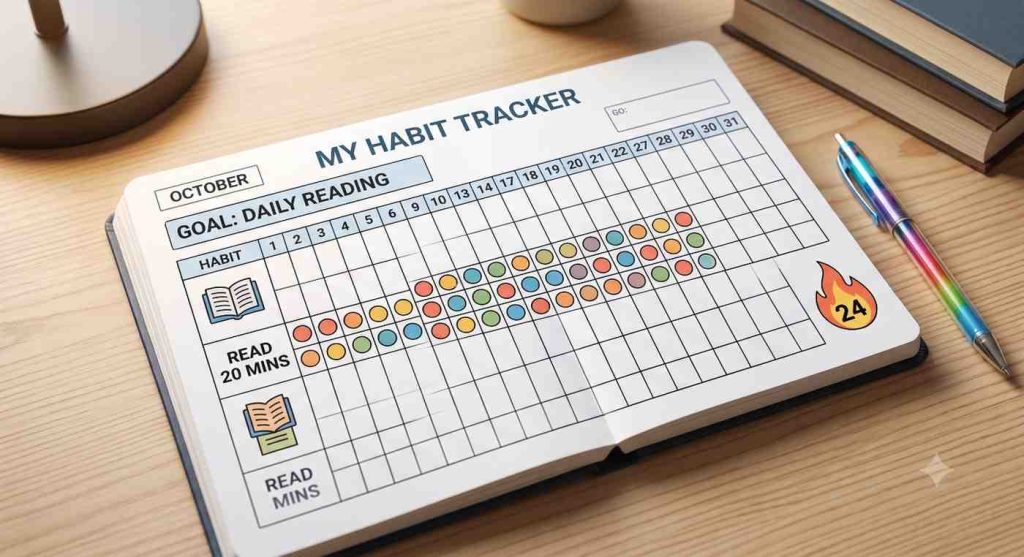
Step 6: Track Your Habits Visually
The brain loves visible progress.
Habit tracking creates psychological momentum — what researchers call the progress principle: the idea that seeing measurable advancement is one of the most powerful motivators in human behavior.
You can use:
- Habit tracking apps (Habitica, Streaks, Loop)
- Physical calendars with X marks
- Journals or bullet planners
- Printable habit trackers
- Simple paper checklists
Every completed day becomes proof that you are becoming the person you want to be.
Even simple streaks can dramatically improve consistency. Don’t break the chain.
Step 7: Never Miss Twice
Missing one day is normal. Missing two days starts a new negative pattern.
Life happens. You will get busy, tired, distracted, or unmotivated. That does not mean the habit is ruined.
Research published in the European Journal of Social Psychology suggests that missing one opportunity to perform a habit does not meaningfully impact long-term habit formation — as long as you return quickly.
The goal is not perfection. The goal is returning quickly.
One bad day does not destroy progress. Quitting does.
When you miss, ask yourself: What is the smallest version of this habit I can do right now? Even 2 minutes counts. The return matters more than the streak.
Step 8: Reward Yourself Immediately
The brain repeats behaviors that feel rewarding.
This is why social media becomes addictive — it delivers instant dopamine. Good habits often fail because the rewards are delayed.
Exercise takes weeks to show physical results. Reading improves knowledge slowly. Studying pays off months later.
So create immediate rewards to bridge the gap:
- Mark a habit tracker (the act of marking itself becomes satisfying)
- Drink your favorite tea after studying
- Listen to a podcast only during workouts
- Celebrate small wins verbally or mentally
- Use temptation bundling — pairing a habit you need to do with something you enjoy
Temptation bundling example: Only listen to your favorite audiobook while going for a run. The run becomes associated with something pleasurable, strengthening the habit loop.
Positive reinforcement strengthens consistency by teaching the brain that the behavior is worth repeating.
How to Make Habits Stick Long-Term
Creating a habit and making a habit stick are two different challenges.
The early days are about starting. Long-term success is about sustaining.
Here is what separates people who maintain habits for years from those who abandon them within weeks:
1. They link habits to their values, not their goals. Goals end. Values don’t. If exercise is linked to “I want to be healthy for my family,” it outlasts “I want to lose 10 kg by June.”
2. They plan for obstacles. Research on implementation intentions (Gollwitzer, 1999) shows that people who plan specifically for when, where, and how they will handle disruptions are significantly more likely to maintain behaviors over time.
Example: “If I miss my morning workout because of travel, I will do 10 minutes of bodyweight exercises in the hotel room instead.”
3. They make the habit satisfying in the moment. Long-term adherence requires that the habit feel good — or at least feel connected to something meaningful — while doing it, not just after.
4. They adjust rather than abandon. Life changes. Circumstances shift. Flexible habit systems — ones that can shrink to a minimal version when needed — survive disruption. Rigid systems collapse.
5. They surround themselves with supportive environments. Social environments are powerful habit shapers. Research by Nicholas Christakis and James Fowler shows that behaviors spread through social networks. Being around people who share your habits makes your own habits far easier to maintain.
Environment Design: The Hidden Force Behind Every Habit
Your environment shapes your behavior more than your willpower does.
In his book Atomic Habits, James Clear dedicates significant attention to this idea: you do not simply choose your habits, you live in environments that make certain behaviors easier or harder.
When your environment is designed for the habit you want, the habit becomes nearly automatic. When your environment is designed against it, even strong motivation eventually fails.
Practical environment design strategies:
| Habit You Want | Environment Change |
|---|---|
| Read more | Place a book on your pillow each morning |
| Drink more water | Put a full glass on your nightstand and desk |
| Exercise more | Sleep in workout clothes or lay them out the night before |
| Eat healthier | Make healthy food the first thing you see in the fridge |
| Use phone less | Charge your phone in a different room at night |
| Study more consistently | Have one desk used only for studying — nothing else |
| Meditate | Place a meditation cushion in a visible spot |
| Journal | Keep your journal on top of your pillow |
The goal is to make the right behavior the default behavior — the path of least resistance.
Keystone Habits: The Habits That Change Everything Else
Not all habits are equal.
Charles Duhigg introduced the concept of keystone habits in The Power of Habit — habits that, when established, naturally trigger a cascade of other positive behaviors.
Common keystone habits include:
- Daily exercise — People who start exercising regularly tend to eat better, sleep more consistently, and become more productive at work without consciously deciding to change those areas.
- Making your bed each morning — William McRaven, in his famous commencement speech at UT Austin, described this as a habit that creates a sense of accomplishment and order that ripples through the rest of the day.
- Meal planning — Tends to reduce impulsive eating, save money, and reduce decision fatigue.
- Journaling — Creates a reflective mindset that improves emotional regulation, goal clarity, and self-awareness.
- A consistent sleep schedule — Improves mood, focus, and self-control across virtually every other habit.
When selecting your first habit to build, prioritize keystone habits. The ROI extends far beyond the habit itself.
Common Habit-Building Mistakes to Avoid
Most habit failures follow predictable patterns. Recognizing them in advance dramatically improves your success rate.
Mistake 1: Starting too big The most common mistake. Beginning with an overly ambitious habit creates immediate friction and near-certain failure. Always start smaller than you think necessary.
Mistake 2: Depending on motivation Motivation fluctuates. Building a habit that only works when you feel motivated means the habit will disappear the moment life gets difficult.
Mistake 3: Tracking too many habits at once Research suggests that working on more than 1–3 new habits simultaneously reduces the success rate of all of them. Focus is not laziness — it is strategy.
Mistake 4: Skipping the reward Without a satisfying outcome — even a small one — the brain has no reason to repeat the behavior. Always attach something pleasurable to the habit, especially in the early days.
Mistake 5: Making the environment hostile If your environment makes the habit harder, you are fighting against your own surroundings every single day. Design your environment first.
Mistake 6: Expecting linear progress Habit formation is not linear. There will be plateaus, regression, and difficult stretches. This is normal. Progress is happening even when it is not visible.
Mistake 7: Treating a missed day as failure Missing one day is not failure. Deciding that missing one day means the habit is over — that is failure. The response to a missed day matters more than the miss itself.
How to Build Healthy Habits That Last
Healthy habits are easier when they fit naturally into your lifestyle.
Do not try to become a completely different person overnight. Focus on sustainable improvement.
Healthy Habits That Change Life Most
Physical Health
- Daily walking (even 20–30 minutes significantly improves cardiovascular health)
- Strength training 2–3 times per week
- Consistent sleep schedule (same bedtime and wake time, even on weekends)
- Drinking water before meals
- Reducing processed foods gradually, not overnight
Mental Health
- Journaling (5 minutes daily improves emotional clarity over time)
- Meditation or mindfulness (even 5–10 minutes per day reduces anxiety)
- Reading books instead of doomscrolling
- Reducing social media to designated time windows
- Practicing gratitude (3 things daily, written, not just thought)
Productivity
- Deep work sessions (distraction-free focus blocks of 60–90 minutes)
- Daily planning (5 minutes each evening for the next day)
- Time blocking important tasks rather than maintaining a to-do list
- Studying at the same time each day
- Setting a daily “shutdown ritual” to signal the end of the workday
The smaller and more repeatable the habit is, the more likely it becomes permanent.
How to Create a Reading Habit

Reading is one of the highest-ROI habits for mental growth, vocabulary, focus, and knowledge accumulation.
But most people fail because they:
- Start with difficult or unenjoyable books
- Set unrealistically high goals (50 books a year when they haven’t read one)
- Treat reading as a chore rather than a pleasure
How to Build a Habit of Reading
Make Reading Easy Choose genuinely enjoyable books first. Not books you should read — books you actually want to read. Pleasure is the gateway to consistency.
Lower the Goal Read 5 minutes daily instead of 1 hour. A 5-minute streak beats a 1-hour intention you never follow through on.
Remove Phone Distractions Keep your phone in a different room while reading, or put it face-down and on silent. One glance at a notification can break the reading flow for 15–20 minutes.
Attach Reading to Existing Routines Read before sleep or after morning coffee. Use habit stacking to anchor the reading habit to something you already do reliably.
Track Progress Seeing completed books, tracked pages, or reading streaks builds momentum. Use Goodreads, a bullet journal, or a simple spreadsheet.
Over time, reading stops feeling forced and becomes part of your identity. You stop asking whether you feel like reading. You simply read — because that is what you do.
How to Build Good Study Habits

Students often confuse studying longer with studying better.
Effective study habits focus on consistency and active engagement — not duration.
Best Study Habit Strategies
Study at the Same Time Daily Consistency trains the brain faster. A fixed study time removes the daily decision of “when should I study?” and makes starting automatic.
Use Active Recall Test yourself instead of rereading notes. Research by cognitive scientists Roediger and Karpicke (2006) consistently shows that retrieval practice — pulling information out of memory — is dramatically more effective than passive review.
Remove Multitasking Your brain cannot actually multitask. Switching between tasks costs cognitive resources and reduces performance on both. Studying with music (especially with lyrics), while checking messages, or with notifications enabled is significantly less effective than focused, single-task studying.
Use Short Focus Sessions Try 25–50 minute study blocks (the Pomodoro Technique recommends 25-minute sessions with 5-minute breaks). The brain’s ability to maintain focused attention degrades over time. Short, intentional sessions often outperform long, unfocused ones.
Create a Dedicated Study Space Environment strongly affects concentration. A space used only for studying becomes a context cue — your brain associates it with focus and activates accordingly. Do not study in bed if you can avoid it. The bedroom context cue associated with sleep and relaxation works against focused cognition.
Good study habits reduce stress because preparation becomes automatic rather than reactive.
How to Create a Healthy Daily Routine
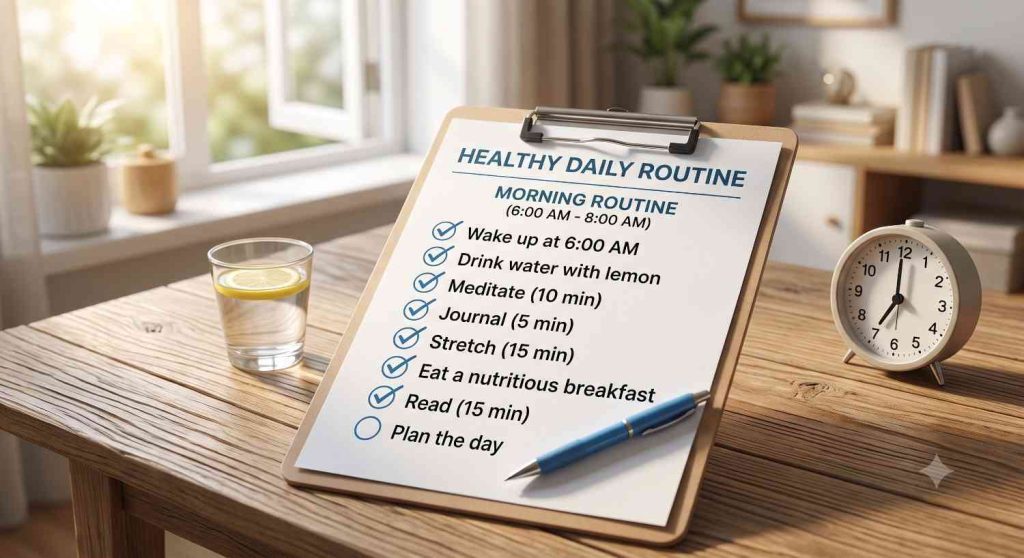
Your daily routine shapes your life more than occasional bursts of motivation.
A strong routine reduces decision fatigue — the mental exhaustion caused by making too many choices throughout the day — and creates a structure within which habits thrive.
Example Healthy Daily Routine
Morning
- Wake up at a consistent time (even on weekends)
- Drink a full glass of water before caffeine
- Stretch or take a 10-minute walk
- Avoid your phone for the first 30 minutes
- Set your top 3 priorities for the day
Afternoon
- Deep work or study sessions during peak cognitive hours
- Eat a balanced lunch away from your desk when possible
- Take brief movement breaks every 60–90 minutes
- Review progress midday and adjust priorities
Evening
- Wind down with reading or journaling
- Reflect on 3 things that went well
- Reduce screen time 60 minutes before bed
- Prepare tomorrow (clothes, tasks, environment) tonight
- Consistent bedtime regardless of how the day went
The goal is not a perfect routine. The goal is a repeatable routine.
Perfection is the enemy of consistency. A 70% routine followed every day beats a perfect routine followed twice a week.
The Truth About the “21 Day Habit” Myth
You’ve probably heard that habits form in 21 days.
This idea originated from a misinterpretation of plastic surgeon Maxwell Maltz’s 1960 observation that post-operative patients took a minimum of 21 days to adjust to their new appearance. Self-help authors later popularized this as a rule rather than an observation — and it became one of the most pervasive myths in personal development.
The science says otherwise.
Phillippa Lally’s 2010 UCL study found that habit automaticity developed over a range of 18 to 254 days, with an average of 66 days. Simpler habits (like drinking water with lunch) formed faster. More complex behaviors (like going for a 30-minute run before work) took significantly longer.
The important thing is repetition, not speed.
There is no shortcut. There is no magic number. There is only consistent repetition until the behavior becomes automatic — and for some habits, that takes considerably longer than three weeks.
Why Identity Change Is the Real Secret
The deepest habits come from identity transformation.
People who successfully maintain habits for years eventually stop forcing themselves. They simply become:
- Readers
- Athletes
- Writers
- Healthy eaters
- Disciplined students
At first, habits feel like effort. Eventually, they become part of who you are.
This is the mechanism James Clear describes in Atomic Habits: habits are not just things you do — they are evidence of who you are. Every time you keep a commitment to yourself, you cast a vote for your identity. Enough votes over enough time, and the identity shifts.
The process looks like this:
- You decide to become a runner (identity intention)
- You go for small runs consistently (behavioral evidence)
- Your brain begins to accept: “I am someone who runs”
- Running stops feeling like a habit and starts feeling like who you are
- Skipping runs starts to feel wrong — because it contradicts your identity
That is where real transformation happens. Not through willpower. Through identity.
How to Create Habits That Stick Forever
If you remember only a few things from this article, remember these:
- Start smaller than you think necessary. The smaller the start, the more certain the start.
- Focus on consistency over perfection. A 70% habit maintained for a year beats a 100% habit abandoned in two weeks.
- Design your environment carefully. Your surroundings shape your behavior more than your willpower does.
- Attach habits to existing routines. Habit stacking removes the need to find a new trigger.
- Build identity-based habits. Goals end. Identity endures.
- Stop depending on motivation. Build systems instead.
- Never miss twice. One miss is normal. Two is a pattern.
- Track progress visually. Make the invisible progress visible.
- Reward yourself immediately. Bridge the gap between action and long-term result with short-term satisfaction.
- Plan for obstacles. Decide in advance what you will do when life disrupts the habit.
Most life changes do not happen dramatically.
They happen quietly through repeated daily actions.
One small habit may not feel powerful today. But repeated over months and years, it can completely change your future.
Final Thoughts
Learning how to create habits is really learning how to redesign your life.
Every action you repeat becomes part of your identity. Every small decision shapes your future self.
The habits you build today quietly determine:
- Your health
- Your confidence
- Your productivity
- Your mindset
- Your relationships
- Your future success
You do not need to transform your entire life overnight.
You only need to start with one small habit and repeat it long enough for your brain to believe: “This is who I am now.”
And once that identity shift happens, everything becomes easier.
Frequently Asked Questions
How long does it take to create a habit?
Habit formation varies depending on the behavior and the person. Research by Phillippa Lally at University College London found an average of 66 days, with a range of 18 to 254 days. Simpler habits form faster; more complex behaviors take longer. The key variable is consistency, not time.
How do I create a habit that sticks?
Use a combination of strategies: start extremely small, attach the habit to something you already do (habit stacking), design your environment to make the habit easy, reward yourself immediately after, and track your progress visually. The single most important factor is consistency — showing up even when the effort is minimal.
What is the best way to make new habits stick?
The most effective methods are habit stacking (attaching the new habit to an existing one), environment design (making the habit easy and visible), identity-based framing (“I am a person who…”), and immediate rewards that reinforce the behavior before the long-term results arrive.
How do I stop quitting habits?
Avoid perfectionism. Missing one day is normal and will not ruin your progress. The key is the “never miss twice” rule — always return the next day. Also reduce the habit to its smallest possible version during difficult periods. Two minutes of journaling beats no journaling at all.
What are the easiest habits to start with?
The best beginner habits are small, low-friction, and high-return. Examples: drinking a glass of water each morning, reading 5 pages before bed, walking for 10 minutes daily, journaling for 2 minutes, and stretching for 5 minutes after waking. These require minimal effort but create momentum and compound over time.
What is habit stacking?
Habit stacking is the practice of attaching a new behavior to an existing habit using the formula: “After I [current habit], I will [new habit].” Because the existing habit acts as a cue, the new behavior becomes anchored to a reliable trigger, making it far easier to remember and repeat.
What is the habit loop?
The habit loop is a neurological pattern identified by Charles Duhigg consisting of four stages: Cue (the trigger), Craving (the desire the cue creates), Response (the action taken), and Reward (the outcome that reinforces the loop). Understanding and intentionally designing this loop is the foundation of successful habit creation.
Why do my habits keep failing?
Most habit failures share common causes: starting too large, depending on motivation rather than systems, neglecting environment design, tracking too many habits simultaneously, or lacking an immediate reward. Identify which of these applies and address it specifically rather than simply “trying harder.”
How do I create habits that last a lifetime?
Long-lasting habits are anchored to identity, not outcomes. When a habit becomes part of who you are rather than something you are trying to achieve, it no longer requires willpower to maintain. Build toward identity change by treating every repetition as a vote for the person you want to become.
Can I build multiple habits at the same time?
You can, but research and practical experience both suggest that focusing on 1–3 habits at a time produces significantly better results than attempting many simultaneously. Once a habit becomes automatic — requiring little conscious effort — it frees up capacity to add the next one.