
Great ideas rarely appear out of nowhere.
Whether you’re an entrepreneur, writer, designer, student, or business owner, understanding the creative process can help you solve problems, generate innovative solutions, and think differently in a world that rewards originality.
Many people believe creativity is a gift that only a few lucky individuals possess. In reality, the creative process is a skill that anyone can learn and improve with practice.
The truth is that nearly every breakthrough invention, successful business, bestselling book, or life-changing innovation follows a similar creative process. Once you understand how the creative process works, you’ll be able to create better ideas more consistently.
Why the Creative Process Matters
Every day, we face challenges that require solutions. Some problems are small, while others can impact entire careers or businesses.
The creative process helps us connect existing ideas in new ways. Instead of waiting for inspiration to strike, the creative process gives us a repeatable framework for generating creative solutions.
Whether you’re building a startup, writing content, creating art, or improving your daily life, mastering the creative process can become one of the most valuable skills you develop.
What Is the Creative Process?
The creative process is the method through which new ideas are discovered, developed, tested, and improved.
Contrary to popular belief, creativity isn’t about inventing something from nothing. The creative process involves combining existing knowledge, experiences, and observations into something useful and unique.
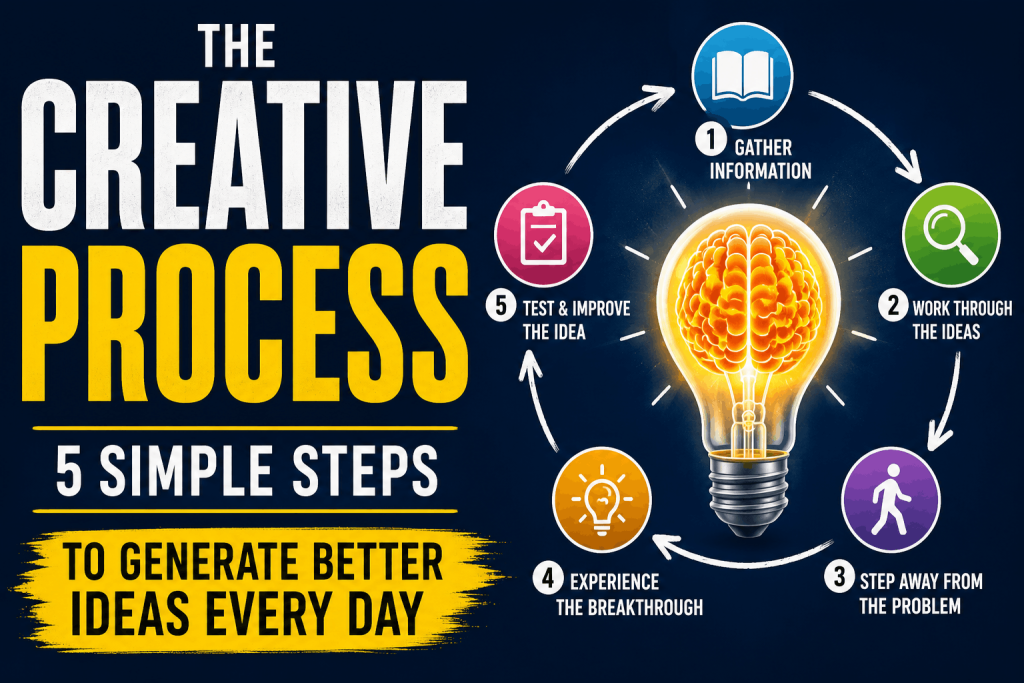
Many researchers and creators have found that the most effective creative process follows five distinct stages.
Let’s explore each step.
Step 1: Gather New Information
Every successful creative process begins with learning.
Ideas need raw material. The more information, experiences, and knowledge you collect, the more connections your brain can make later.
Read books. Watch documentaries. Learn new skills. Talk to different people. Explore industries outside your own.
The foundation of every strong creative process is curiosity.
Without enough input, creativity has little material to work with.
How to Improve This Stage
- Read daily
- Listen to podcasts
- Take notes on interesting ideas
- Learn from multiple industries
- Ask more questions
The richer your knowledge base, the stronger your creative process becomes.
Step 2: Work Through the Ideas
After gathering information, the next stage of the creative process is analysis.
This is where you begin examining ideas from different angles.
Ask yourself:
- What patterns do I notice?
- What problems remain unsolved?
- How could these ideas connect?
- What would happen if I combined two unrelated concepts?
This stage often feels difficult because the brain is actively searching for relationships between ideas.
A powerful creative process requires experimentation and exploration.
Many people quit here because they don’t immediately find answers. However, persistence during this stage often leads to breakthroughs later.
Step 3: Step Away From the Problem
One of the most overlooked parts of the creative process is taking a break.
When you’ve spent hours or days thinking about a problem, your conscious mind becomes exhausted.
Stepping away allows your subconscious mind to continue working.
Go for a walk.
Exercise.
Listen to music.
Spend time in nature.
Sleep.
Many famous inventors, writers, and entrepreneurs discovered their best ideas only after temporarily leaving the problem behind.
The creative process often works best when you stop forcing solutions.
Step 4: Experience the Breakthrough
This is the stage most people associate with creativity.
Suddenly, an idea appears.
The solution becomes clear.
The connection finally makes sense.
This moment of insight is a natural outcome of the creative process, not random luck.
Your brain has been quietly processing information in the background and eventually delivers a new combination of ideas.
While this stage feels magical, it only happens because the earlier stages of the creative process were completed properly.
The breakthrough is the reward for preparation.
Step 5: Test and Improve the Idea
A great idea is only the beginning.
The final stage of the creative process involves refinement.
Share your idea.
Gather feedback.
Make improvements.
Test different approaches.
Adapt based on results.
Most successful innovations go through multiple revisions before achieving success.
The creative process doesn’t end when an idea appears. It ends when the idea becomes useful in the real world.
Common Mistakes That Hurt the Creative Process
Many people unknowingly weaken their creative process by making simple mistakes.
Waiting for Motivation
Creativity often comes after action, not before it.
Consuming Without Creating
Learning is important, but the creative process also requires execution.
Fear of Failure
Many innovative ideas seem strange at first. Don’t reject ideas too quickly.
Quitting Too Early
The most difficult phase of the creative process often occurs just before a breakthrough.
How to Build a More Creative Mind
If you want to strengthen your creative process, focus on habits that encourage curiosity and experimentation.
Try these strategies:
- Read widely across different topics
- Keep an idea journal
- Schedule thinking time
- Limit distractions
- Seek diverse experiences
- Learn continuously
- Test ideas quickly
Over time, these habits improve the quality of your creative process and increase the number of ideas you generate.
Final Thoughts
The creative process isn’t reserved for artists, inventors, or geniuses.
Anyone can develop a stronger creative process by following five simple steps:
- Gather information
- Analyze and connect ideas
- Step away from the problem
- Allow insights to emerge
- Test and refine your ideas
The next great idea probably isn’t something completely new.
More often, it’s the result of a well-developed creative process that helps you connect existing ideas in a better way.
Master the creative process, and you’ll never have to rely on inspiration alone again.